Cloud of Witnesses · Theologians
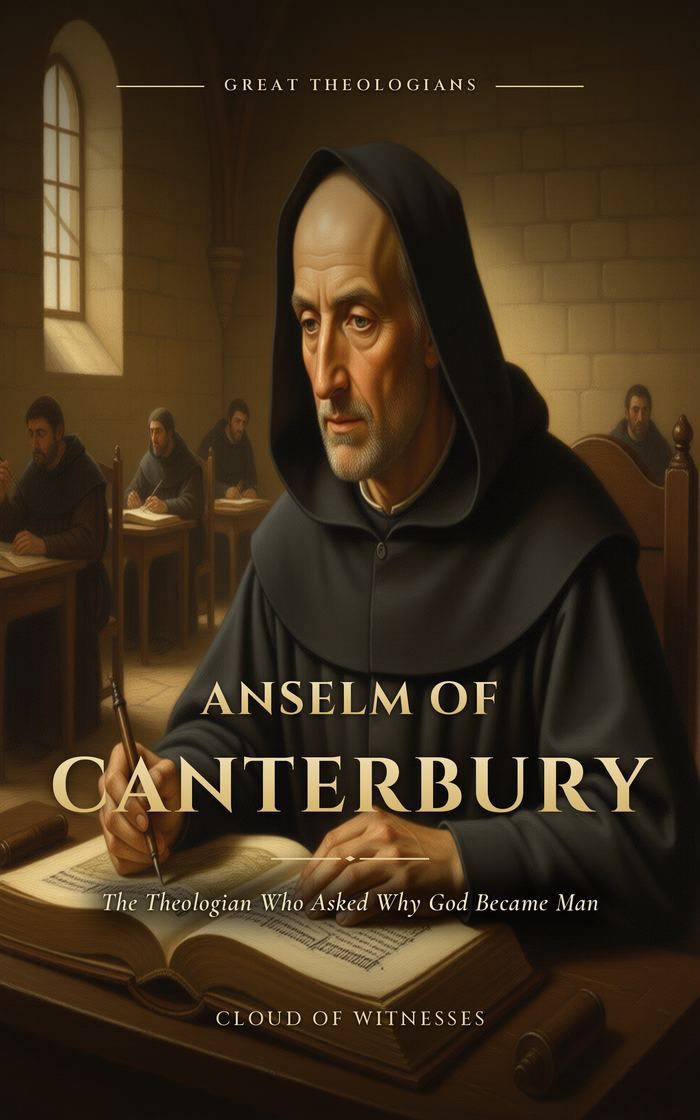
Anselm of Canterbury
The Theologian Who Asked Why God Became Man
- Series
- Cloud of Witnesses
- Sub-series
- Theologians
- Published
- Other edition
- Anselmo de Cantuária (Portuguese)
The Aosta Valley, northern Italy, around 1033. A contemplative boy grows up among snow-covered mountains, under the spiritual influence of a devout mother — until her death shatters his entire family stability and sends him, still young, on foot across the Alps toward an uncertain destination.
Years of pilgrimage would lead Anselm to the Benedictine monastery of Bec, in Normandy, where he would find his true master — Lanfranc — and, decades later, would formulate alone, after months of nearly obsessive contemplative search, one of the most discussed philosophical arguments in the entire history of western thought: the ontological argument for the existence of God, still debated by philosophers nearly a thousand years later.
Reluctant and physically resistant before his own nomination, Anselm would become archbishop of Canterbury in 1093 — a position that would lead him to directly confront two successive English kings in defense of the church's freedom, paying the price of two forced exiles. It was precisely during the first of them that he would write Cur Deus Homo, a work that would establish the satisfaction theory of atonement, the foundation on which reformers like Luther and Calvin would build, centuries later, their own doctrines of salvation.
This biography, drawn entirely from documented sources, follows the complete trajectory of the man tradition would recognize as the founder of medieval Scholasticism — from the alpine valley of his childhood to Canterbury Cathedral, where he would die in 1109, leaving an intellectual legacy that would span nearly a thousand years of history.