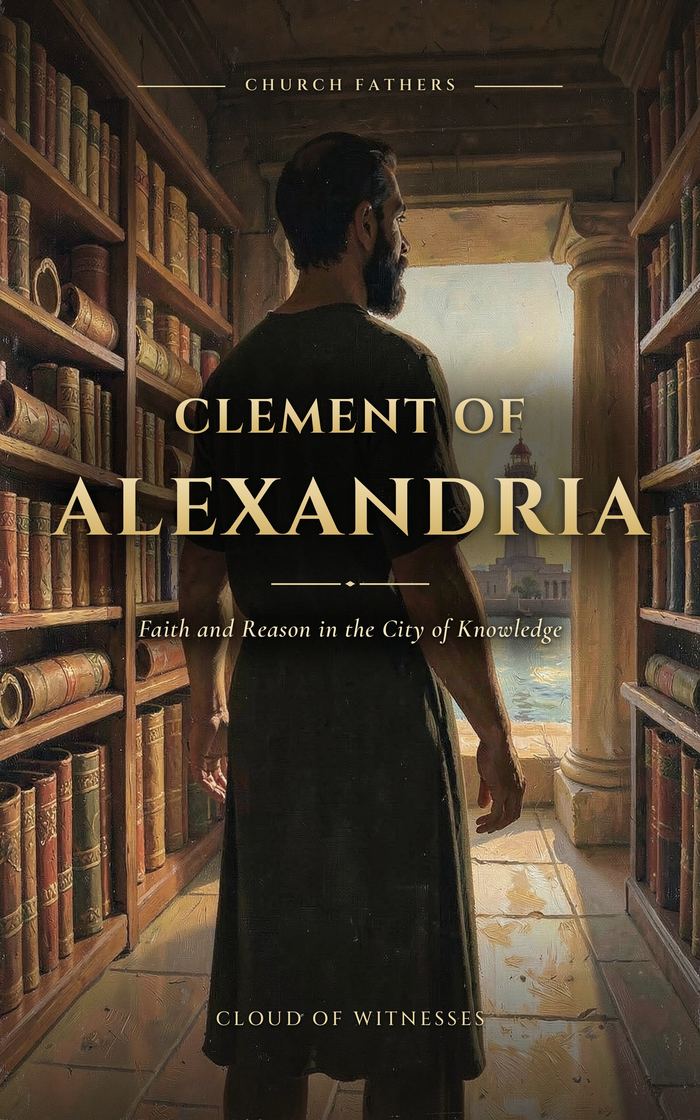
Cloud of Witnesses · Church Fathers
Clement of Alexandria
Faith and Reason in the City of Knowledge
- Series
- Cloud of Witnesses
- Sub-series
- Church Fathers
- Published
- Other edition
- Clemente de Alexandria (Portuguese)
Around 202 AD, a teacher respected after decades of instruction fled the city he had helped turn into one of the great intellectual centers of early Christianity. He wasn't fleeing a lost argument — he was fleeing an imperial persecution that had already killed others. What he left behind was a bold project: proving that Greek philosophy, far from being the enemy of Christian faith, could be its ally.
This narrative biography reconstructs the life of Clement of Alexandria, drawing on his own works — the Protrepticus, the Paedagogus, and the Stromata — and on Eusebius of Caesarea's Historia Ecclesiastica. A pilgrim among philosophical schools in Greece, Italy, and the East before settling in Alexandria, Clement became a disciple and later successor of Pantaenus at the head of the Catechetical School, one of the first great centers of advanced Christian teaching.
Follow the building of his central trilogy, from the apologetic invitation to educated pagan readers to the ethical formation of the convert, all the way to his most ambitious work: the Stromata, a mosaic of philosophical-theological reflection where the figure of the true Christian "gnostic" is born — the believer of mature knowledge and virtuous life, in deliberate contrast to the heretical Gnosticism that Irenaeus of Lyon fought. See too the teacher who would shape, directly or indirectly, one of patristics' greatest names: Origen.
This biography does not hide history's real uncertainties: it honestly distinguishes what comes from Clement's own works from what is modern scholarly hypothesis — from his probable birthplace to the undocumented final details of his death in Cappadocia.
Grounded in Clement's own writings and in Eusebius of Caesarea, this is the story of the man who tried to reconcile Athens and Jerusalem centuries before the question became a classic one.
Ideal for readers of early church history, patristics, and Christian biography who want historical rigor without hagiography.