Cloud of Witnesses · Church Fathers
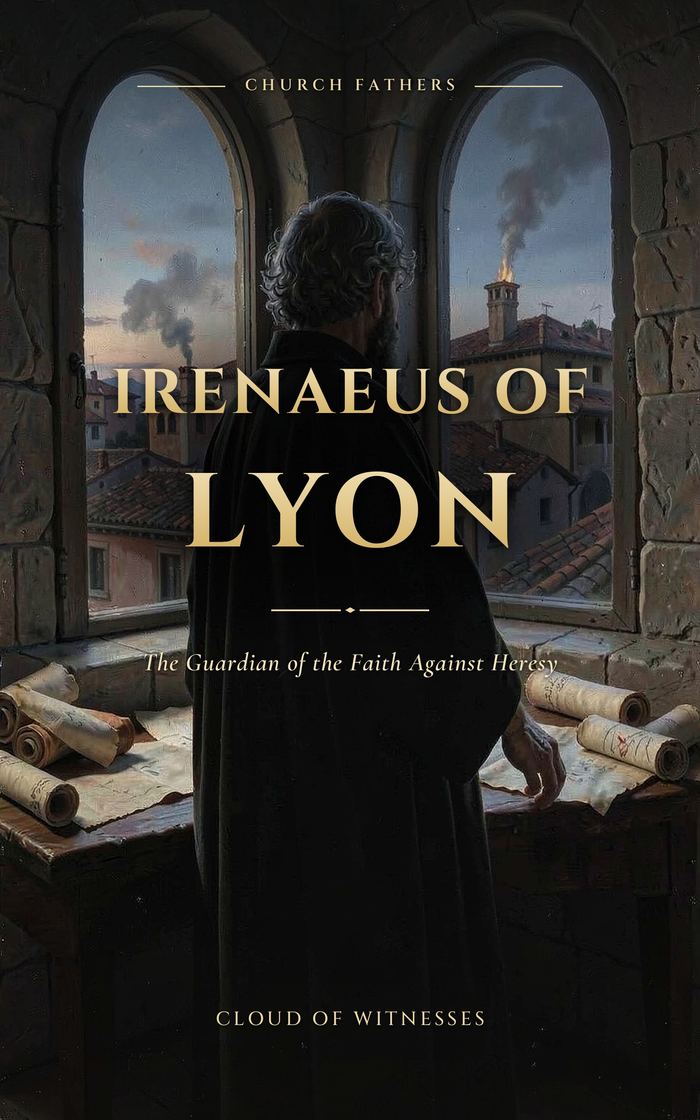
Irenaeus of Lyon
The Guardian of the Faith Against Heresies
- Series
- Cloud of Witnesses
- Sub-series
- Church Fathers
- Published
- Other edition
- Irineu de Lyon (Portuguese)
Around 177 AD, an enraged mob in Lyon dragged Christians off to public torture and execution in the amphitheater. A young presbyter from the same church escaped the massacre because, at that very moment, he was on the road to Rome — carrying a letter. Decades later, he would be remembered not for what he survived, but for what he wrote.
This narrative biography reconstructs the life of Irenaeus of Lyon, the first great systematic theologian of the Christian church, drawing on his own works — Against Heresies and the Demonstration of the Apostolic Preaching — and on Eusebius of Caesarea's Historia Ecclesiastica. Formed in Asia Minor at the feet of Polycarp of Smyrna, Irenaeus carried that living memory of the apostolic generation into Roman Gaul, where he would become bishop of Lugdunum after the martyrdom of his predecessor Pothinus.
Follow the writing of Against Heresies, the five books in which Irenaeus dismantles, system by system, the Valentinian Gnosticism that threatened to divide the church around a supposed "secret knowledge" — and where he first articulates the arguments of apostolic succession and recapitulation, Christ as the new Adam who sums up and restores all of humanity. See a different Irenaeus too: the mediator who, years later, intervened in the dispute between the bishop of Rome and the churches of Asia Minor over the date of Easter, defending diversity of practice without breaking communion.
This biography does not hide history's real uncertainties: it honestly distinguishes what comes from Irenaeus's own letters from what is later tradition — including the account of his martyrdom under Septimius Severus, attested only by a sixth-century source — and treats the Gnostic systems with the real complexity Irenaeus himself recognized, not as caricature.
Grounded in Irenaeus's own writings and in Eusebius of Caesarea, this is the story of the man who, between the silence of persecution and the noise of heresy, gave the Christian church its first great systematic theological architecture.
Ideal for readers of early church history, patristics, and Christian biography who want historical rigor without hagiography.