Polycarp of Smyrna was a Christian bishop in Roman Asia Minor, born still in the first century, who became one of the clearest living links between the apostolic generation and the church of the second century. He grew up hearing firsthand accounts from people who had known Jesus, and he later led the church in Smyrna — one of the seven churches named in the book of Revelation — for decades, until his death by martyrdom in old age.
How was Polycarp connected to the apostles?
Polycarp belonged to the generation that came right after the apostles themselves. Irenaeus of Lyon, who as a young man in Asia Minor had sat under Polycarp's own teaching before later becoming bishop of Lyon, is the source closest to Polycarp's own memory. Irenaeus recalled Polycarp speaking directly about his conversations with "those who had seen the Lord," preserving that testimony for a church already moving a generation further from the events of the Gospels. This connection is also why Irenaeus is one of the clearest windows historians have into Polycarp's life — a debt this catalog's own biography of Irenaeus traces back to the years he spent formed at Polycarp's side in Asia Minor, in Irenaeus of Lyon: The Guardian of the Faith Against Heresies.
What happened when Polycarp met Ignatius of Antioch?
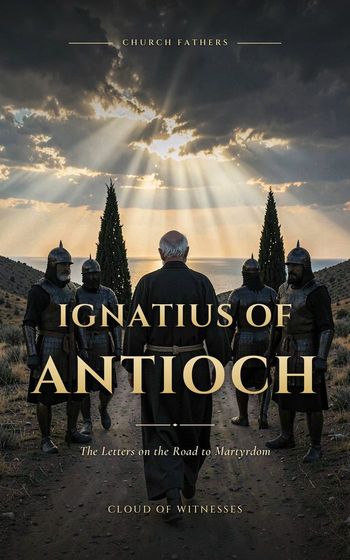
Sometime between 107 and 110 AD, Ignatius of Antioch, bishop of one of the empire's largest cities, was marched under armed guard toward Rome to be executed in the arena. Along that route through Asia Minor, Ignatius stopped in Smyrna and met Polycarp, a younger bishop he treated like a son. Ignatius wrote a personal letter to Polycarp during that journey, alongside letters to several churches he passed, urging steadiness in the faith and unity around the local bishop. The meeting left a mark on both men's ministries: Ignatius's letters became some of the earliest surviving Christian writings outside the New Testament, and Polycarp himself later helped preserve and circulate them among the churches of Asia Minor. The full story of that journey to martyrdom is told in Ignatius of Antioch: The Letters from the Road to Martyrdom.
Why did Polycarp travel to Rome?
Later in life, by then an old man, Polycarp made the long journey from Smyrna to Rome to meet with the bishop of Rome, Anicetus, over a disagreement that had been dividing churches for years: the date on which to celebrate the resurrection of Christ. Churches in Asia Minor, following a tradition they traced back to the apostle John himself, kept the celebration tied to the Jewish Passover date, while Rome and other regions kept it on the following Sunday. Polycarp and Anicetus did not resolve the calendar dispute in that meeting — each city kept its own custom — but they parted in communion with one another, a decision that modeled how the early church could hold real disagreement without breaking fellowship.
Did Polycarp confront heresy directly?
Yes. During that same visit to Rome, Polycarp came face to face with one of the most influential false teachers of the second century, a figure whose followers were already spreading his teaching that the God of the Old Testament was different from the Father of Jesus Christ. According to the account preserved by Irenaeus, when the man asked Polycarp if he recognized him, Polycarp answered that he recognized him as "the firstborn of Satan" — a blunt public rebuke, remembered because it showed how seriously Polycarp treated doctrinal fidelity, even face to face with someone once inside the church.
How did Polycarp die?
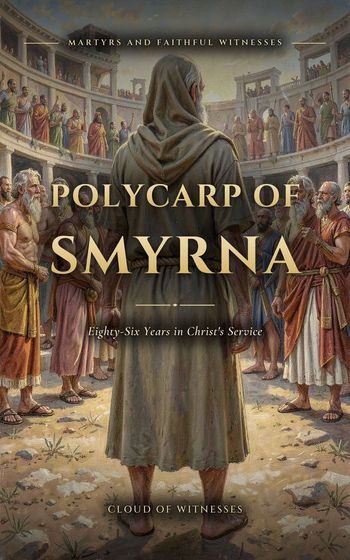
Polycarp was killed in Smyrna's amphitheater, arrested after being betrayed and brought before a Roman proconsul who pressed him repeatedly to curse Christ and save his own life. His answer is one of the best-preserved lines from any early Christian martyr, recorded by eyewitnesses in the account written by the church of Smyrna shortly afterward:
"Eighty and six years have I served Him, and He has done me no wrong. How then can I blaspheme my King who saved me?"
That number — eighty-six years — measured a lifetime of ordinary pastoral faithfulness that only became famous in its final hour. It gives this catalog's own biography of him its title: Polycarp of Smyrna: Eighty-Six Years in Christ's Service.
What are the oldest sources about Polycarp's life?
Polycarp's story rests on some of the oldest Christian documents outside the New Testament that survive from a named individual: his own Letter to the Philippians, written to a church he had pastoral concern for; the personal testimony of Irenaeus of Lyon, who had known him directly; and the Martyrdom of Polycarp, an account composed by the church of Smyrna not long after his death, widely regarded as one of the earliest martyr narratives in Christian history. Together, these sources let historians reconstruct Polycarp's life with unusual confidence for someone born so close to the apostolic age. For the wider picture of how figures like Polycarp, Ignatius, and Irenaeus fit into the first centuries of the church, our timeline of the early Church Fathers traces that generation step by step.
Where to read more about Polycarp and his circle
Polycarp's life connects directly to two other figures in this catalog who shaped the same corner of the second-century church. Ignatius of Antioch treated him as a spiritual son during his final journey to martyrdom, and Irenaeus of Lyon carried Polycarp's own memory of the apostles into the theological battles of the next generation. Readers who want the full narrative — his decades as bishop, the journey to Rome, the confrontation over heresy, and the final scene in the amphitheater — will find it in Polycarp of Smyrna: Eighty-Six Years in Christ's Service, part of the Cloud of Witnesses series of narrative biographies on the early church.