Cloud of Witnesses · Church Fathers
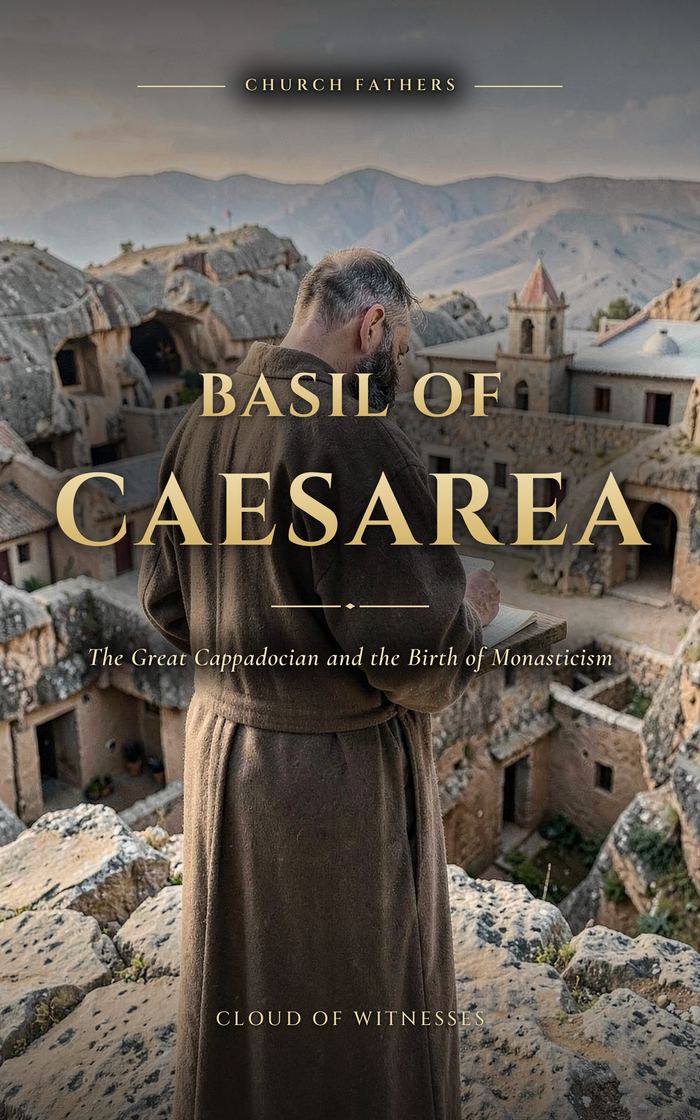
Basil of Caesarea
The Great Cappadocian and the Birth of Monasticism
- Series
- Cloud of Witnesses
- Sub-series
- Church Fathers
- Published
- Other edition
- Basílio de Cesareia (Portuguese)
An imperial prefect sympathetic to Arianism came to confront him, threatening confiscation of property, exile, torture, and death. According to the account preserved by his closest friend, the bishop answered that none of it frightened him — and that the prefect had perhaps never met a real bishop before. The confrontation sums up a man who built, at the same time, hospitals for the poor and the theological architecture that would define the divinity of the Holy Spirit.
This narrative biography reconstructs the life of Basil of Caesarea, drawing on his own works — De Spiritu Sancto, the Monastic Rules, his vast correspondence — and on the funeral oration written by Gregory of Nazianzus, his friend from student years in Athens. Born into a Cappadocian family remarkable for its piety (brother of the ascetic Macrina and of Gregory of Nyssa), Basil fused institutional organization and doctrinal conviction like few other Church Fathers.
Follow the founding of his model of communal monasticism, distinct from the solitary Egyptian model; the creation of the Basileiad, a pioneering charitable complex with a hospital and shelter for the poor; the carefully diplomatic defense of the divinity of the Holy Spirit; and the real tension that Gregory's consecration as bishop of Sasima brought to their friendship — an ecclesiastical decision, not a personal betrayal, but one with a real cost to his friend.
This biography does not treat the careful language of De Spiritu Sancto as doctrinal hesitation — modern scholarship reads it as deliberate pastoral strategy — nor does it turn Basil into villain or victim in the Sasima episode, presenting both sides with the balance the sources allow.
Grounded in Basil's own works and Gregory of Nazianzus's funeral oration, this is the story of the bishop who united doctrine, monastic discipline, and concrete care for the poor into a single coherent vocation.
Ideal for readers of early church history, patristics, and Christian biography who want historical rigor without hagiography.