Cloud of Witnesses · Reformers
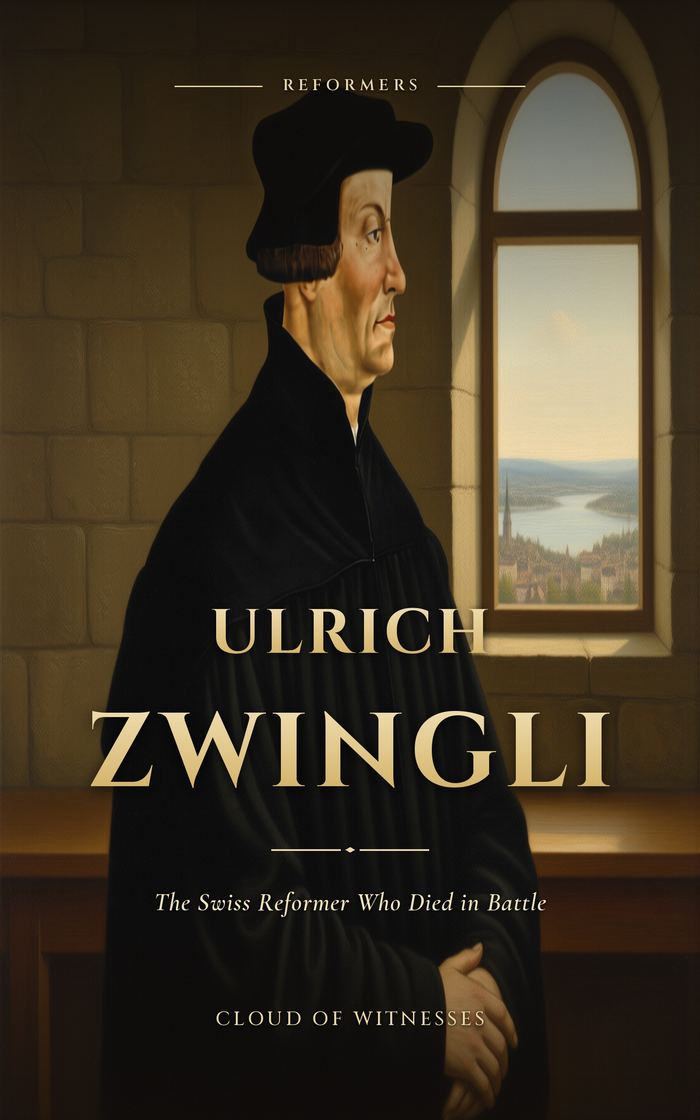
Ulrich Zwingli
The Swiss Reformer Who Died in Battle
- Series
- Cloud of Witnesses
- Sub-series
- Reformers
- Published
- Other edition
- Ulrico Zuínglio (Portuguese)
A chaplain rides toward a hill called Kappel, helmet and mail already on, alongside soldiers who have never seen real combat. Hours earlier he would have said he carried no weapon to fight with. By the end of that October afternoon in 1531, the enemy finds him among the wounded, hands folded, eyes turned to the sky. He refuses, by gesture, the confession offered by a Catholic priest. He is recognized, called a heretic, and run through with a sword. The body of Switzerland's most powerful reformer is quartered like a traitor's.
Twelve years earlier, that same man had climbed into the pulpit of Zurich's Grossmünster and done something no preacher there had done before: announced that he would preach through the Gospel of Matthew chapter by chapter, straight from Erasmus's Greek text, ignoring the church's traditional lectionary. From that decision would come a break that abolished the Mass, tore images out of churches, split Switzerland into Reformed and Catholic cantons — and, months before his death, sat him across a table from Martin Luther, unable to agree with him on the meaning of a single verse.
This narrative biography reconstructs the life of Ulrich Zwingli: from the boy born on New Year's Day 1484 in an Alpine village to the military chaplain who witnessed the battlefields of Italy and became the sharpest critic of the Swiss mercenary trade; from the parish priest who broke the Lenten fast in the name of Christian liberty to the theologian who confronted his own former disciples turned Anabaptists; from Erasmus's correspondent to Luther's doctrinal opponent at Marburg — to the day the very policy he had helped build sent him, chaplain rather than soldier, into the middle of a war he would not survive.
Ideal for readers of Reformation history, Reformed theology, and Christian biography who prefer honest historical reconstruction over uncritical hagiography.