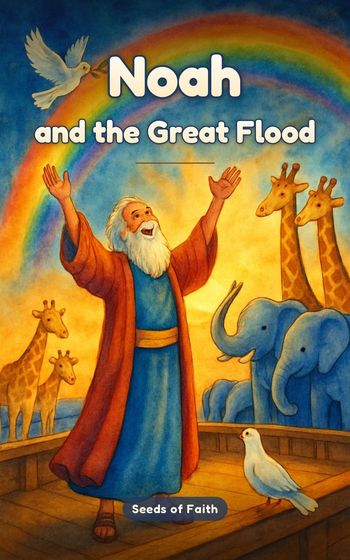
The Noah's ark story for kids works best when it's told as Genesis 6-9 actually tells it: God commands one obedient man to build a massive boat on dry land, with no rain anywhere in sight, and Noah keeps building for years while his neighbors mock him, until the sky finally changes and the family, the animals, and the ark's cargo of patient obedience are all that survive the flood that follows.
What does Genesis 6-9 actually say happened?
Scripture is specific about details that popular retellings often blur. God gives Noah the command to build the ark long before there's any visible sign of rain, and Noah obeys through what the text implies is years of construction, plank after plank, while people around him presumably go on with ordinary life, unconvinced. The animals come into the ark two by two, and the flood itself lasts forty days and nights, though the family remains inside considerably longer while the earth dries. At the end, God establishes a covenant and sets a rainbow in the sky as its sign. None of this is complicated for a six-year-old to follow — the story is naturally sequential, with a clear beginning, middle, and end, which is part of why it works so well as a first deep Bible story.
What do cartoon versions of Noah's ark often get wrong?
Two details get flattened almost every time the story gets simplified for very young audiences. First, Genesis says it was God, not Noah, who shut the door of the ark — a small detail that actually matters, because it shows the flood as something God controlled from beginning to end, not a natural disaster Noah managed to survive through his own foresight. Second, the rainbow belongs only at the very end of the story, after the water recedes and the family steps back onto dry ground — not scattered through the story as decoration the way it sometimes appears in picture books and animated versions. Telling Noah's story with both of those details in the right place is a small thing, but it keeps the story's real point intact: this was God's plan, God's mercy, and God's promise, not primarily a story about a resourceful man and his boat.
Is the flood too scary for a 6- to 8-year-old?
The flood carries real weight — it is, after all, a story about judgment as well as rescue — but told at the right pace for this age, it doesn't need to be frightening. The story keeps its focus on what a child can hold onto emotionally: one family staying faithful together, animals coming safely aboard two by two, and a long wait that ends in dry ground and a promise in the sky. A version written specifically for ages 6 to 8, with illustrations built for that age and language that doesn't dwell on the destruction outside the ark, keeps the story age-appropriate without softening what actually happened. That's the approach taken in Noah and the Great Flood, which follows Genesis 6-9 closely while keeping the telling gentle enough for the youngest readers.
How can I talk with my child about Noah's story after reading?
The most useful conversations after this story tend to be simple ones: why did Noah keep building even when no one else believed him, what does it feel like to do the right thing when people are laughing at you, and what does the rainbow mean now, every time your child sees one in the sky. A book written for this age typically closes with a verse to keep in your heart and a short set of questions built for exactly this kind of conversation, so you're not left improvising discussion questions on the spot after the last page.
It also helps to let the story repeat. Noah's ark tends to become one of the books a young child asks for again and again, and that repetition is doing real work — a story a child already half-knows is one they can start noticing new details in, like the years of waiting before the rain ever falls, or the fact that Noah never sees a single cloud before he starts building. Reading it more than once in the same month isn't a sign your child is stuck; it's usually a sign the story is settling in.
Why is Noah's ark often a child's first deep Bible story?
Noah works well as a starting point for a reason beyond its familiarity: it has one family, one clear command, and one outcome, without the larger cast of characters that later stories like Joseph's or Moses's will introduce. A child can hold the whole shape of the story in their head after a single reading, which makes it easier to talk about afterward than a story with several named characters and subplots. That simplicity is exactly why it's worth reading with care rather than rushing past it — it's often the story that teaches a young child what it feels like to follow a Bible story from beginning to end.
What should we read next after Noah?
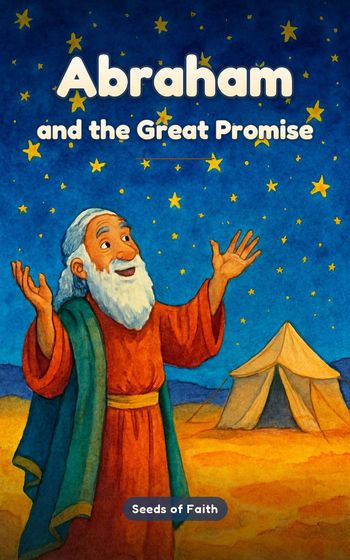
Once a child has settled into Noah's story, Abraham and the Great Promise is a natural next step. It moves from a story about obedience over a few years to one about obedience stretched across decades — a man who leaves everything he knows for a land God hasn't shown him yet, and who waits far longer than Noah did to see a promise fulfilled. Read it in Abraham and the Great Promise. If you'd rather see the full recommended order for this age group before choosing what comes after Abraham, our guide to where to start with Bible stories for kids lays out six books in sequence.
Start tonight with the full story
Noah's ark, told faithfully and at the right pace, gives a young child a story worth returning to again and again — one about obeying even when no one else understands why, and about a God who keeps every promise he makes. The complete story, illustrated for ages 6 to 8 with a closing verse and discussion questions built in, is Noah and the Great Flood, part of the Little Seeds of Faith series for young readers.