More than a century before Martin Luther nailed anything to a church door, three men in three different countries had already argued that Scripture belonged to ordinary people, not to a clergy that alone could read and interpret it. Peter Valdo in twelfth-century Lyon, John Wycliffe in fourteenth-century Oxford, and Jan Hus in early-fifteenth-century Prague never met each other, yet each one fed directly into the next — and Luther himself, generations later, would recognize the debt.
Who was Peter Valdo, and why does no one know his real name?
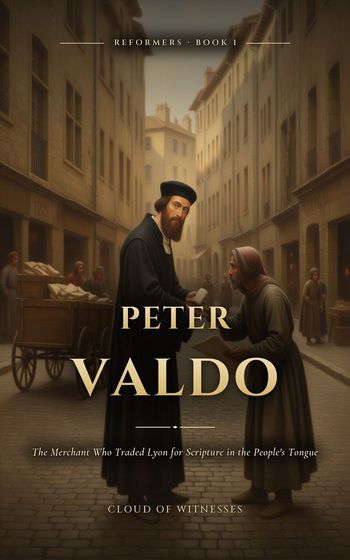
A wealthy merchant in Lyon, the man later biographies call Peter Valdo, was sitting at dinner when a man at the table simply dropped dead, with no warning at all. Shaken, the merchant sought out a priest and asked the surest path to heaven. Taken literally, the answer he received from a single gospel verse led him, within a few years, to sell everything he owned and spend the rest of his life as a homeless itinerant preacher. We don't even know this man's true given name — the chroniclers closest to his own time call him simply "Valdo." What we do know is what his gesture set in motion: a project to translate the Bible into the language of the people, serious enough a threat that the church excommunicated him as a schismatic, and a movement that survived, clandestine, for more than three hundred years in the Alpine valleys, outlasting a papal crusade and a massacre that shocked Protestant Europe. Even a papal crusade and a massacre notorious enough to inspire one of the most remembered sonnets in the English language couldn't finish the movement off. Centuries later, reformers who had never heard of Valdo would recognize, in manuscripts his followers had quietly preserved, the same conviction that moved them — and the church that grew from his gesture still exists today, on three continents, eight hundred years after a merchant's dinner in Lyon.
What did John Wycliffe actually teach that got him condemned?
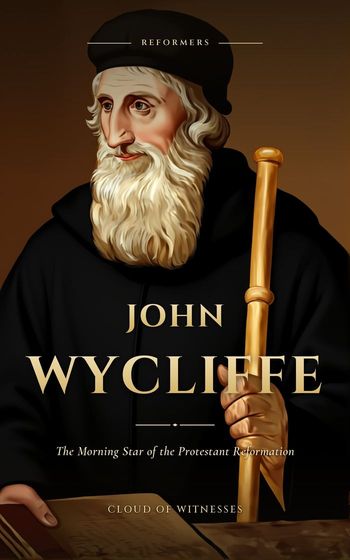
John Wycliffe spent decades at Oxford as a respected philosopher, defending a technical position most of his colleagues already considered outdated — that concepts like "substance" had real existence, not just conventions of language. No one expected that debate to end up threatening the center of medieval religious life, the Mass itself. Wycliffe began as a trusted advisor to the English crown, protected by one of the realm's most powerful men. He ended expelled from Oxford, his doctrines condemned as heresy, his followers scattered across Europe as itinerant "poor preachers," and — more than forty years after he died naturally and peacefully in 1384 — his own bones were dug up, burned, and thrown into a small river by order of an international council. Between those two points stood a translation of the Bible into English, whose exact authorship is still debated by scholars, and an unjust accusation of stirring up the most violent peasant revolt in English history.
How did Wycliffe's ideas reach Jan Hus in Bohemia?
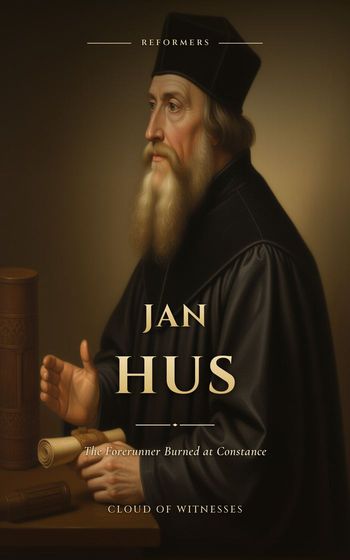
Jan Hus grew up carving wooden spoons in a peasant household and became, decades later, the most influential preacher Bohemia had ever produced. He rose to the pulpit of Prague's Bethlehem Chapel in 1402, and within a few years was rector of the University of Prague and confessor to the queen herself. Wycliffe's manuscripts reached him through an unlikely route: a royal marriage had carried them across the sea from England to the Bohemian court years earlier, and Hus found in them the same conviction Wycliffe had defended at Oxford — that God's Word belonged to every Christian, not to a caste of intermediaries reading it only in Latin. Hus publicly denounced the sale of indulgences, permanently splitting his old academic allies, and was eventually summoned to the Council of Constance under a formal guarantee of safe conduct from a future emperor. That guarantee stopped neither his arrest nor his condemnation to the stake, where he was burned in 1415. His execution, far from silencing him, inflamed Bohemia into nearly two decades of war.
Did Martin Luther know about any of this?
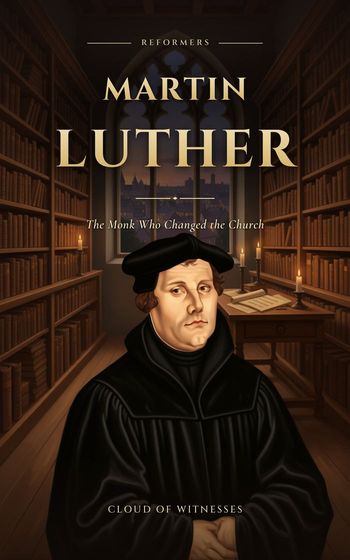
More than a century after Hus burned at Constance, Martin Luther studied the case closely enough to make a declaration that still startles readers today: "We are all Hussites without knowing it." Luther's own break with Rome, chronicled from his Erfurt years of spiritual anguish to his refusal to recant before pope and emperor, followed the same basic conviction Valdo had acted on with his fortune and Wycliffe and Hus had defended from their pulpits — that Scripture, not clerical authority alone, has the final word. The difference is that Luther survived to see his movement take root across half of Europe, something none of his three forerunners lived to witness.
Where to start reading about the forerunners of the Reformation
Begin with Peter Valdo, whose story shows how far one man's private conviction could travel over centuries. Move to John Wycliffe, the Oxford philosopher whose ideas outlived his own bones. Then read Jan Hus, who paid at the stake in 1415 the price Wycliffe never had to pay. Finish with Martin Luther, who inherited the same fight more than a hundred years later and finally saw it succeed. All four biographies are part of the Cloud of Witnesses series, and reading them in this order traces one unbroken argument across four centuries and four countries. For the detail of what Luther's own protest looked like on paper, the piece on his ninety-five theses picks up exactly where this one leaves off.